Central Noida vs Noida Expressway: A Sector-by-Sector Location Guide
Compare Central Noida and the Noida Expressway corridor across metro lines, road access, housing stock, service maturity and cost, with the exact checks to run per sector.
- Author
- Ananya Verma
- Category
- Comparisons
- Date
- July 2, 2026
- Reading time
- 12 min
Answer: Central Noida and the Noida Expressway are marketing labels, not administrative boundaries, so the honest comparison is corridor by corridor, not name by name. Central Noida usually points to established sectors and the newer 70s belt (such as 74 to 79 and 119 to 121) plus older central sectors that sit on the Delhi Metro Blue Line and mature internal arterials; the Noida Expressway means the sectors flanking the Noida-Greater Noida Expressway, which are newer, high-rise heavy, and served by the NMRC Aqua Line. Both sit inside Noida under the NOIDA Authority and UP RERA, and both are largely leasehold. The right choice depends on your exact project gate, your daily destinations, the operational (not future) metro station nearest that gate, and total cost per usable carpet area, so verify each at the sector and unit level before you compare.
Independent guide: we do not quote live prices, approvals or returns. Verify project-specific facts against current official documents before acting.
First, define what each label actually means
Neither "Central Noida" nor "Noida Expressway" is an official administrative unit. Both are locality and marketing terms, so two brochures can draw the boundaries differently for the same building. Before you compare prices or travel times, write down the exact sector number for each option and confirm whether it falls under the NOIDA Authority (Noida) or the Greater Noida Industrial Development Authority (GNIDA), because that changes the allotting body, the dues and the process you will deal with.
In common usage, Central Noida groups the newer 70s residential belt (sectors such as 74, 75, 76, 77, 78 and 79) and the 119 to 121 pocket together with older, long-settled central sectors. "Noida Expressway" refers to the residential sectors that flank the Noida-Greater Noida Expressway spine, including pockets in the 90s and 100s and the 125 to 150 range. These groupings overlap and shift, so treat the label as a starting hint and the sector number as the fact.
The practical consequence is simple: a project sold as "on the Expressway" may still need a long service-road approach to reach the main carriageway, and a "central" project may enjoy strong regional access but a congested final junction. Compare the specific gate, not the headline name.
Same authority, same tenure question
Both corridors sit within Noida, in the district of Gautam Buddh Nagar, Uttar Pradesh, regulated for real estate by UP RERA. That means the registration, complaint and progress-report tools you would use are identical across both locations: search the exact project and promoter on the UP RERA portal and record the registration number and status for your specific phase.
Authority land in Noida is predominantly leasehold, allotted by the NOIDA Authority, so a developer's rights flow from an allotment or lease and its conditions rather than from freehold ownership. This is true on both corridors and is decision-relevant for transfer, dues and resale. Do not assume tenure from the brochure; confirm the tenure, the lease conditions and any outstanding dues for the specific plot with the authority and a property lawyer.
Because governance and tenure are common to both, they are not a reason to prefer one corridor over the other. The genuine differences are connectivity, housing-stock age, service maturity and cost, covered below.
The metro difference: Blue Line versus Aqua Line
Connectivity is the clearest structural difference between the two corridors, and it comes down to which metro line is actually operational near your gate. The Delhi Metro Blue Line (operated by DMRC) serves the older, established central sectors, with stations at Sector 15, Sector 16, Sector 18, Noida City Centre and, on its extension, Sector 61 and Sector 62; Botanical Garden is an interchange between the Blue Line and the Magenta Line. These stations anchor much of the established central belt.
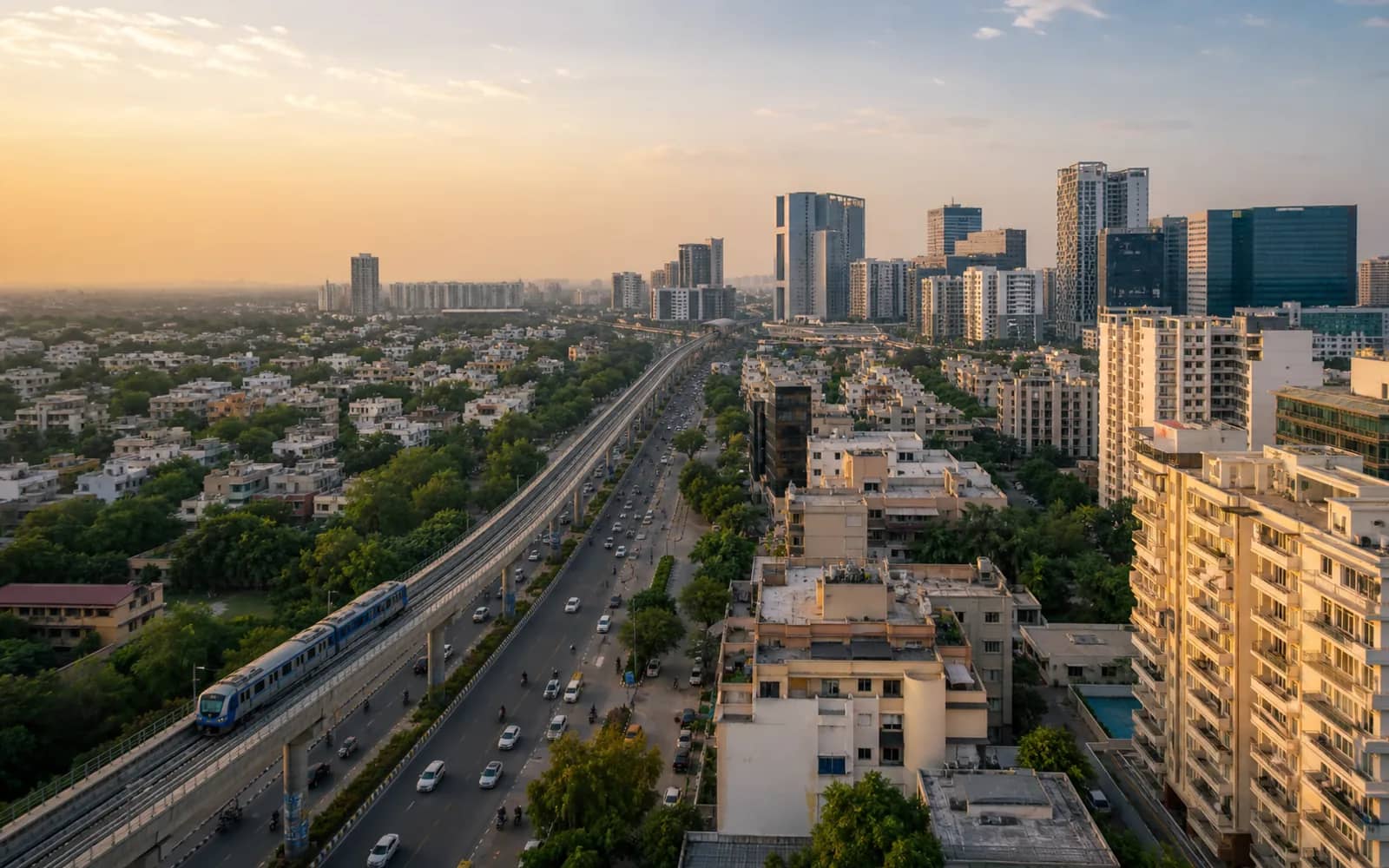
The Noida-Greater Noida Expressway corridor is served by the Aqua Line, which is owned by the Noida Metro Rail Corporation (NMRC) and has been operational since January 2019, running from Noida Sector 51 to the Greater Noida depot. It broadly parallels the Expressway, with stations serving sectors such as 76, 101, 137 and 142 to 148. So an Expressway-corridor home typically relies on the Aqua Line, while a central home more often relies on the Blue Line, and interchange time between the two networks matters if your job and home sit on different lines.
Extensions have been announced along and across this corridor, including a link from Botanical Garden towards Sector 142 and a Sector 51 to Knowledge Park V line. As of 2026 these are approved or under construction, not open. Verify the current status of any extension on the NMRC site and treat only operational stations as connectivity; never let a promised future station carry your commute decision.
Road access and the real commute
The Expressway corridor's advantage is the Noida-Greater Noida Expressway itself, a high-speed spine that connects towards Greater Noida and links to the wider network. Its risk is dependence on interchanges and service roads: a unit can be near the carriageway on a map yet slow to enter or exit at peak times. Established central sectors usually offer more internal arterials and multiple route choices toward Delhi via DND Flyway and Kalindi Kunj, which can mean more redundancy when one route clogs.
Map the door-to-door journey for every regular traveller in the household: office, school, caregiving, and any airport or railway connection. Test weekday peak conditions and include parking, interchange, feeder and walking time, not just the distance. A corridor that depends on a single junction has a different reliability profile from one with alternatives.
Use at least two viable routes for each option and record the times you actually observe, dated, rather than the times a sales team quotes. Connectivity is only a benefit if it is operational today and reachable from your gate.
- Nearest operational metro station and walking or feeder distance from the gate
- Peak and off-peak door-to-door time on at least two routes
- Interchange time if home and office are on different metro lines
- School and daily-care transport routes
- Weekend cross-NCR movement and airport or railway access
Housing stock and service maturity
The two corridors tend to differ in the age and character of what is built. Established central sectors often mix older societies with the newer 70s-belt towers, and their surrounding markets, schools and healthcare are frequently more settled and visibly occupied. Expressway sectors skew toward newer high-rise supply and larger planned communities, but completion levels and surrounding occupancy can vary sharply from one pocket to the next.
Do not generalise from age. A well-operated older society can outperform a poorly run new one on maintenance and daily life, while a well-delivered new project may offer more efficient services and contemporary layouts. Inspect each building: occupancy, common-area upkeep, water and power arrangements, and how the facility is actually staffed and billed.
For services, list what the household uses weekly (groceries, healthcare, schools, recreation, domestic support, public transport) and check what is genuinely operational from the gate, not what is drawn on a masterplan. A family moving in now needs a current-service plan; treat future retail and institutional plots as separate, unconfirmed items.
Side-by-side comparison
The table summarises the structural differences that are checkable today. Every entry still needs sector-level and unit-level verification, because both labels cover a range of pockets. Use it to frame your shortlist, then confirm each row for your specific project.
| Dimension | Central Noida (established and 70s-belt sectors) | Noida Expressway corridor |
|---|---|---|
| Primary metro | Delhi Metro Blue Line (DMRC): Sector 15, 16, 18, City Centre, 61, 62; Botanical Garden interchange | Aqua Line (NMRC), operational since 2019: stations near sectors 76, 101, 137, 142 to 148 |
| Road spine | Multiple internal arterials; routes to Delhi via DND Flyway and Kalindi Kunj | Noida-Greater Noida Expressway; access via interchanges and service roads |
| Housing stock | Mix of older societies and newer 70s-belt high-rise | Predominantly newer high-rise and larger planned communities |
| Service maturity | Often more settled markets, schools and healthcare in older sectors | Varies by pocket; some services still developing |
| Tenure | Largely leasehold under NOIDA Authority (verify per plot) | Largely leasehold under NOIDA Authority (verify per plot) |
| Regulator | UP RERA (verify project and phase) | UP RERA (verify project and phase) |
Price, rent and the resale audience
Do not compare on headline price. Compare total acquisition cost against usable carpet area for similar unit condition, floor, parking and readiness, then add maintenance, IFMS and the commute cost you measured. A lower entry figure on one corridor does not mean better value if vacancy, unfinished surroundings or a longer commute reduce utility.
This guide does not quote prices, circle rates or rents, because those change and a stale number can mislead you into a poor decision. Instead, pull the current circle rate for your exact sector from the Uttar Pradesh registration portal (IGRSUP) before you model stamp duty and registration, and gather achievable rents from current, comparable, occupied units rather than launch brochures.
Then identify the likely future renter or buyer for each option and why that person would choose that corridor. Employment access along the Expressway helps only when the specific unit and final route fit the target tenant; an established central location's premium needs support from durable, operational convenience, not just its label.
How to decide: a weighted scorecard
Turn the comparison into a scorecard. Give the highest weight to your non-negotiable daily needs (say, a specific commute ceiling or a school route), then score each exact project on dated evidence rather than reputation. Keep subjective preferences such as a skyline view separate from operational measures such as travel reliability and service availability.
Always run the downside case for each option: a delayed metro extension that never priced in, a job-location change, higher-than-expected maintenance, or slower resale in a still-filling pocket. The corridor you choose should remain acceptable even without the most optimistic assumption about future infrastructure.
If the scores are close, let the operational facts break the tie: the corridor with a working metro station near the gate, two reliable road routes, occupied neighbours and settled services carries less execution risk than the one whose advantages are still under construction.
Questions buyers and tenants ask
Which sectors count as Central Noida?
There is no official boundary, but the label commonly covers the 70s residential belt (sectors such as 74 to 79) and the 119 to 121 pocket alongside older central sectors. Confirm the exact sector number and its authority for any project rather than relying on the marketing name.
Does the metro connect both corridors directly?
They are served by different lines: established central Noida sits on the Delhi Metro Blue Line, while the Expressway corridor is served by the NMRC Aqua Line. Check the nearest operational station and the walking or feeder distance from your specific gate, and factor in interchange time if home and work are on different lines.
Is Central Noida better than the Noida Expressway for families?
Neither is better universally. Central Noida may offer more settled services in some sectors while Expressway projects may offer newer housing, so compare the household's exact commute, school routes, operational services and building management before deciding.
Is the Noida Expressway cheaper than Central Noida?
This guide does not quote prices because rates change and vary sector by sector. Pull the current circle rate for each exact sector from the IGRSUP portal, then compare total acquisition cost per usable carpet area for similar condition and readiness.
Will the airport and new metro lines boost the Expressway corridor?
Do not let unopened or still-developing infrastructure carry your price or commute decision; verify the current status of the Noida International Airport at Jewar and any Aqua Line extension on the official YEIDA, airport and NMRC sources before you weigh them. Even where a project has reached operations, count it only if the specific road or metro access from your gate is usable today, because a corridor's access routes can lag the headline milestone.
How to verify this yourself
- Confirm the exact sector number for each option and whether it falls under the NOIDA Authority or GNIDA, since "Central Noida" and "Noida Expressway" are marketing labels, not administrative boundaries.
- Identify the nearest operational metro station (Blue Line via DMRC or Aqua Line via NMRC) and measure the walking or feeder distance from the project gate, not from the sector centroid.
- Verify the current status of any metro extension, such as the Botanical Garden to Sector 142 link, on the NMRC site before counting it as connectivity.
- Confirm leasehold tenure, lease conditions and any outstanding authority dues for the specific plot with the NOIDA Authority and a property lawyer.
- Pull the current circle rate for each exact sector from the IGRSUP portal before modelling stamp duty and registration, rather than using any quoted figure.
- Search the exact project and promoter for each shortlisted unit on the UP RERA portal and record the registration number and phase status.
Sources and where to verify
- Noida Metro Rail Corporation (NMRC) - Aqua Line
- Delhi Metro Rail Corporation (DMRC) - Blue Line
- NOIDA Authority (New Okhla Industrial Development Authority)
- UP RERA - project and promoter search
- IGRSUP - Uttar Pradesh registration and stamp portal