Noida Builder Due Diligence: 12 Checks Before You Book
A 12-check due-diligence process for vetting a Noida builder before booking, with the exact UP RERA, NCLT and IGRSUP steps to verify every claim yourself.
- Author
- Rohan Chadha
- Category
- RERA & Legal
- Date
- June 28, 2026
- Reading time
- 10 min
Answer: Before you book with a Noida builder, run 12 checks in order: confirm the exact legal entity receiving your money, verify the precise UP RERA registered phase, read the land tenure and approvals, search litigation and insolvency records, match filed progress reports to dated site evidence, review prior delivery, stress-test the payment plan and builder-buyer agreement, inspect construction quality, and study resident and facility operations. Reputation is not due diligence; each entity, parcel, phase, approval set and agreement must be checked independently against a primary source. Where a fact changes over time, pull the current value from UP RERA, NCLT or the Gautam Buddh Nagar registration portal rather than trusting a brochure.
Independent guide: we do not quote live prices, approvals or returns. Verify project-specific facts against current official documents before acting.
Checks 1-2: Match your money to the legal entity, then to the exact phase
The first failure point in a Noida booking is paying a brand while contracting with a different party. A single project can involve a group brand, the landowner, a development manager and a special-purpose company that actually signs the agreement and receives payment. Match the name on your cheque, the bank beneficiary, the allotment letter and the builder-buyer agreement to the same legal entity, and confirm the person signing holds written authority for that entity.
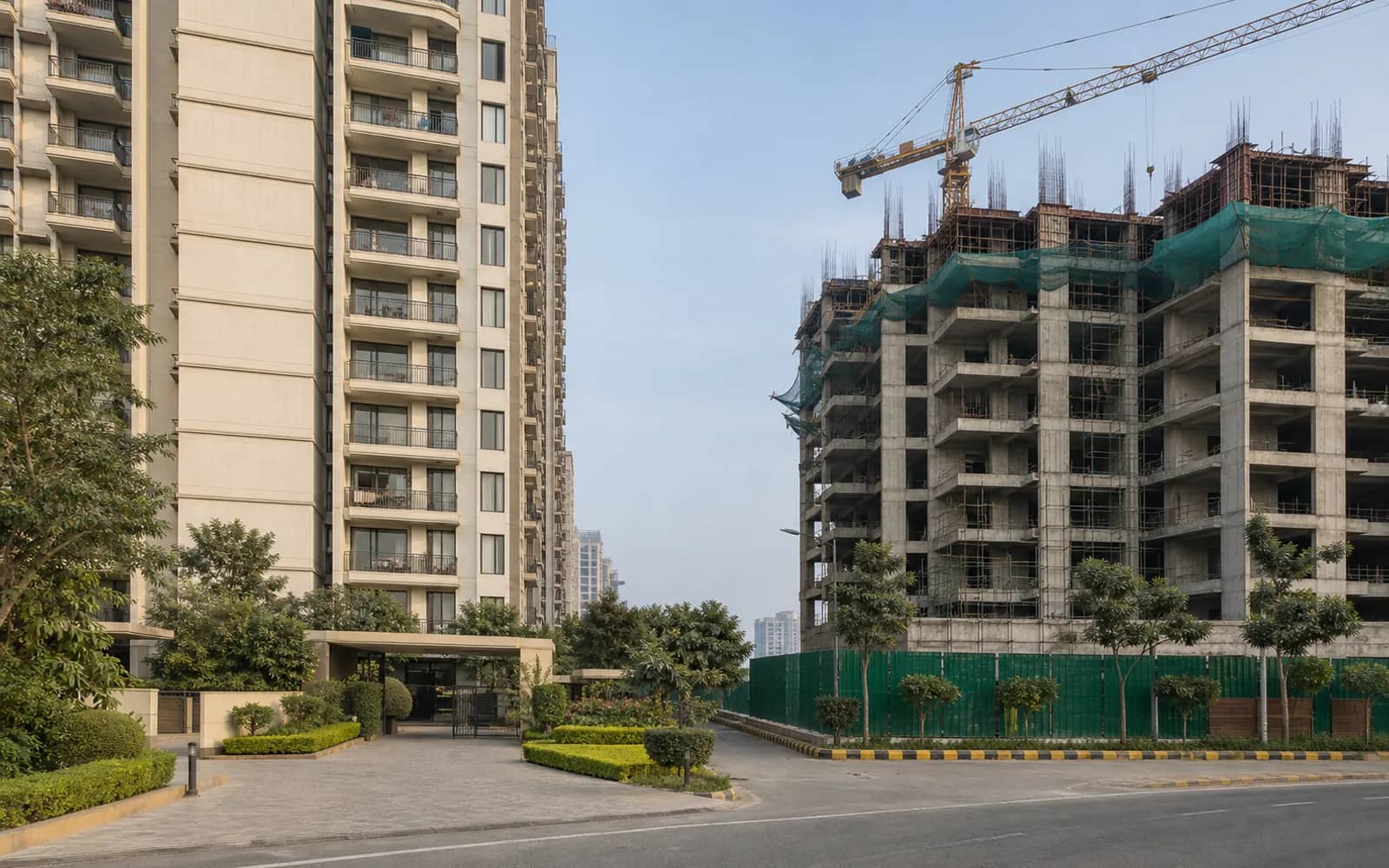
Next, verify the specific phase that contains your unit. Large Noida and Greater Noida developments are frequently registered in separate phases, each with its own UP RERA registration number, approvals, schedule and completion obligation. A booking in an unregistered or lapsed phase carries different risk from one in a live registration, even inside the same gated project. Search the exact project and promoter on the UP RERA portal and record the registration number, validity and declared completion date for your phase, not for the marketing name of the whole township.
- Promoter and contracting entity (must be identical across all documents)
- Bank account and payment beneficiary name
- UP RERA registration number for your specific phase or tower
- Written authority of the individual signing on the entity's behalf
Checks 3-4: Read land tenure, approvals and the sanctioned plan
Authority land in Noida, Greater Noida and the Yamuna region is predominantly leasehold, allotted by NOIDA, GNIDA or YEIDA, so the developer's rights flow from an allotment or lease and its conditions. Ask a qualified property lawyer to review the land or allotment basis, any declared encumbrances, dues to the authority and any condition that could affect transfer, use or completion. Confirm tenure for your specific plot rather than assuming it from the project brochure.
Separately, confirm what has been approved and what has only been proposed. Review the sanctioned building plan and the approvals disclosed in the UP RERA filing, and check that the tower, height and unit you are offered actually appear in the sanctioned plan. For a project or phase that claims to be complete, ask for the Completion Certificate or Occupancy Certificate and verify it applies to your building, because a near-finished appearance is not proof that a unit can legally be handed over.
Checks 5-6: Search litigation, then insolvency and adverse RERA status
A clean sales pitch does not mean a clean legal record. Search for disputes involving the legal entity and the project across the relevant forums using the exact entity name: consumer and civil court records, the UP RERA complaints and orders sections, and, for company-level distress, the National Company Law Tribunal (NCLT) and the Insolvency and Bankruptcy Board of India (IBBI). Noida has seen builder insolvency proceedings before, so this is not a theoretical check.
The UP RERA portal itself carries dedicated searches for projects in adverse states, including NCLT, de-registered, abeyance and withdrawn projects. Check whether your entity or project appears in any of these lists before you pay. A single online mention is not a verdict; a dispute needs its current status and a lawyer's interpretation. But an undisclosed insolvency filing, a de-registration, or a pattern of buyer complaints is a decision-changing signal you should never learn about after booking.
- UP RERA: Registered Project, Registered Promoter, and complaints/orders search
- UP RERA specialised lists: NCLT, de-registered, abeyance, withdrawn projects
- NCLT (nclt.gov.in) case status and IBBI (ibbi.gov.in) insolvency orders
- Consumer and civil court case-status search for the exact legal entity
Checks 7-8: Compare filed progress reports to site evidence and delivery history
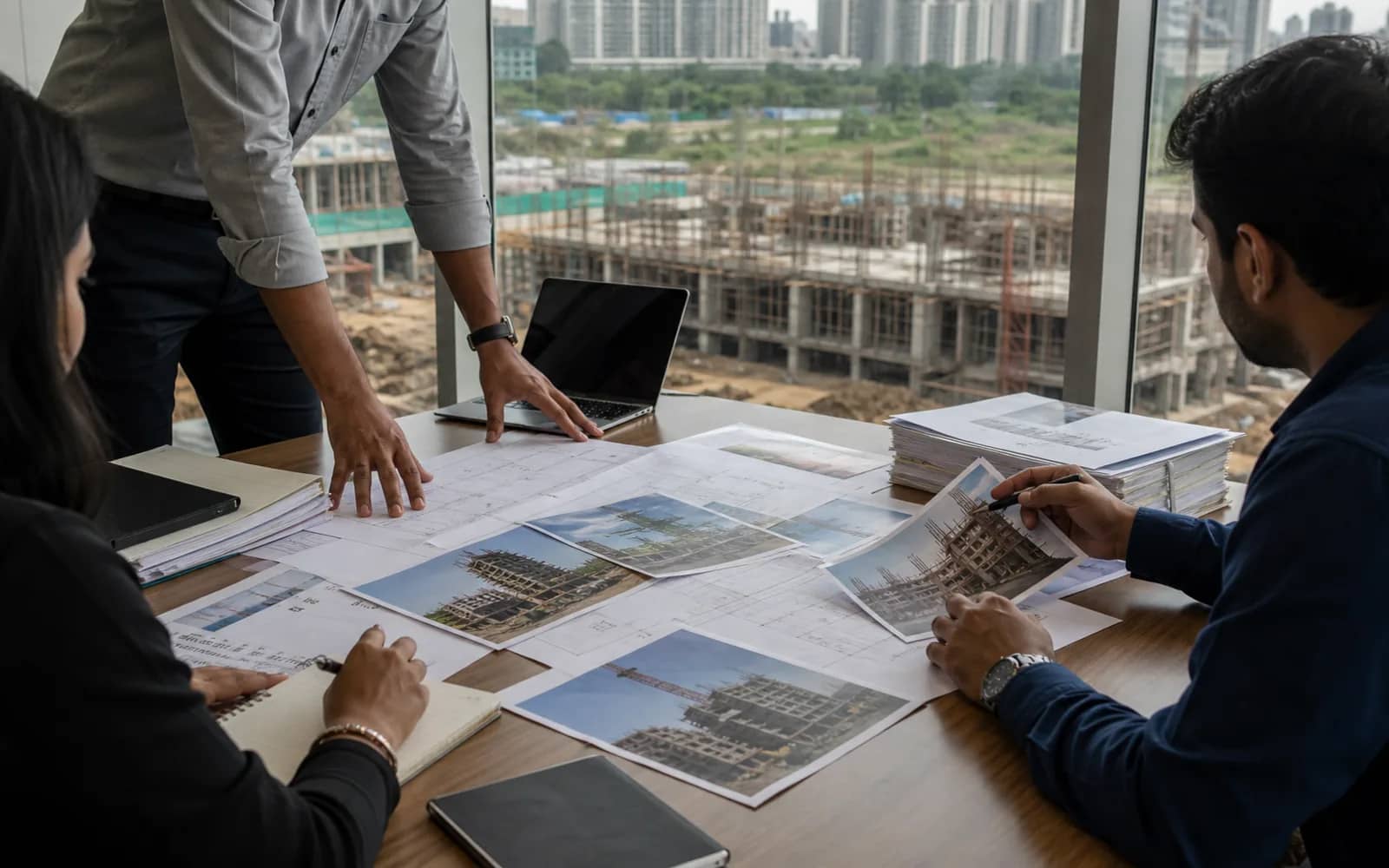
UP RERA requires promoters to file a Quarterly Progress Report (QPR) for each registered project, updating construction status, approvals and key milestones. Pull the latest QPR for your phase and compare it against your own dated site observation. Look beyond the structure to the work that actually delays possession: internal services, facades, lifts, common areas, external development, fire systems, testing and the final approvals. A QPR that is stale or contradicts what you see on the ground is itself a warning.
For the builder's earlier projects, compare what was promised with what was delivered: possession timing versus the original schedule, specification promised versus installed, and how completed buildings are actually maintained. Use documents and corroborated resident evidence rather than a single showcase tower. One flagship delivery does not guarantee that a different entity, phase or parcel will perform the same way, so weigh the record of the specific entity you are contracting with.
Checks 9-10: Stress-test the payment plan and the builder-buyer agreement
Map every instalment in the payment plan to a defined construction event and calculate your cash exposure at each stage. Front-loaded plans that collect a large share before meaningful construction shift risk onto you. Clarify every charge beyond the base price: applicable taxes including GST on under-construction property, statutory stamp duty and registration, parking, club and utility charges, maintenance deposits and IFMS, and the deductions on cancellation. For under-construction purchases, model your rent-plus-EMI overlap if delivery slips.
The agreement, not the brochure, controls your rights. Read the possession definition, the delay and compensation provisions, the developer's change and area-adjustment rights, the specification schedule, transfer and default terms, defect-liability responsibility and the dispute-resolution clause before you sign. Where the agreement and the sales presentation disagree, the agreement wins. Have a property lawyer review any clause that lets the developer alter the plan, the area or the timeline without a real remedy for you.
Checks 11-12: Verify the product, construction quality and after-possession operations
Match the offered unit precisely to the sanctioned plan and written specification: the tower, floor, orientation, carpet area and finish schedule. Identify which items in a show flat are upgrades or loose furniture that will not be delivered. Where construction quality or handover condition is material, engage a technical professional to examine water management, the facade, basement, fire access, lift planning and long-term maintainability, not only the apartment finishes.
Finally, look past handover to how completed buildings are staffed, billed and maintained. Speak to residents of the builder's occupied projects about defects, snag resolution and maintenance patterns, while distinguishing builder responsibility from decisions made by the residents' association. A high-quality asset still fails owners if its operations are not sustainable once the sales team has left, so treat facility management as part of the product you are buying.
Green flags versus red flags, and where to verify each
The checks above resolve into a small set of signals. Treat green flags as necessary, not sufficient: they lower risk but do not replace document-level review by your own lawyer and, where relevant, a technical professional. Treat any single red flag as a reason to pause and verify from the primary source before you pay a rupee.
The table below maps common signals to the official place you confirm them. Every entry is checkable by you or your advisor without relying on the developer's own marketing.
| Signal to test | Green flag | Red flag | Where to verify |
|---|---|---|---|
| Entity and phase | Payee, agreement and RERA registration name all match | Money goes to a party not named in the registration | UP RERA Registered Project and Promoter search |
| RERA status | Live registration with valid completion date | Appears under NCLT, de-registered or abeyance lists | UP RERA project-status searches |
| Litigation and insolvency | No material undisclosed disputes | Active insolvency or repeated buyer complaints | NCLT, IBBI, court case-status, UP RERA orders |
| Progress | QPR matches dated site evidence | Stale QPR or filings contradicting the site | UP RERA QPR for your phase, plus a site visit |
| Cost and taxes | Every charge itemised in writing | Vague or shifting charges and premiums | Agreement, plus IGRSUP for stamp duty and circle rate |
Questions buyers and tenants ask
How can I check a builder in Noida before booking?
Start with the exact legal entity and its UP RERA registered phase on the UP RERA portal, then verify land tenure and approvals, search NCLT and court records for disputes, compare the filed Quarterly Progress Report against dated site evidence, and review the agreement, construction quality and resident experience. Each item is checkable against a primary source rather than the builder's marketing.
Does a well-known builder name remove project risk?
No. Each legal entity, land parcel, registered phase, approval set, construction schedule and agreement must be verified independently, because one flagship delivery does not guarantee that a different entity or phase will perform the same way.
How do I know if a Noida project is in trouble financially?
Search the National Company Law Tribunal (NCLT) and IBBI for insolvency proceedings against the legal entity, and check the UP RERA lists of NCLT, de-registered and abeyance projects. Also read the UP RERA complaints and orders and confirm the latest Quarterly Progress Report is current.
What is the biggest builder due-diligence mistake?
Relying on brand reputation or a sales presentation without matching the offered unit to the contracting entity, the registered phase, the written agreement and current filed evidence. The agreement and RERA record, not the brochure, define your actual rights.
Where do I verify the current stamp duty and circle rate for my Noida sector?
Use the Uttar Pradesh Stamp and Registration portal (IGRSUP) at igrsup.gov.in, which publishes the notified valuation list by district and sub-registrar office. Pull the current figure yourself rather than trusting a number quoted in a sales sheet, and take professional advice on GST for under-construction property.
How to verify this yourself
- Confirm the payment beneficiary, allotment letter and builder-buyer agreement all name the identical legal entity, and that the signatory holds written authority for it.
- Verify the UP RERA registration number, validity and declared completion date for your specific phase or tower, not for the overall project brand.
- Check whether the entity or project appears in the UP RERA NCLT, de-registered, abeyance or withdrawn lists, and search NCLT and IBBI for insolvency proceedings.
- Pull the latest Quarterly Progress Report for your phase and reconcile it against a dated on-site observation of services, common areas and approvals.
- Confirm land tenure (leasehold allotment or lease) and no-dues for the specific plot with a property lawyer, and that your tower and unit appear in the sanctioned plan.
- Verify the current stamp duty, registration fee and circle rate for the sector on IGRSUP before modelling total acquisition cost.
Sources and where to verify
- UP RERA official portal (registered project, promoter, adverse-status lists and RERA registration verification)
- National Company Law Tribunal (NCLT) case status
- Insolvency and Bankruptcy Board of India (IBBI)
- IGRSUP, UP Stamp and Registration Department (circle rate and stamp duty)